Evidence Assessment Scale
Evaluating the Evidence
For centuries, reports of Bigfoot have fueled one of North America's greatest wilderness mysteries. Thousands of eyewitness accounts, unusual footprints, unexplained vocalizations, photographs, and physical traces have been collected by researchers, outdoor enthusiasts, and investigative organizations. While no single piece of evidence has achieved universal scientific acceptance, each contributes to a growing body of information that continues to be examined and debated.
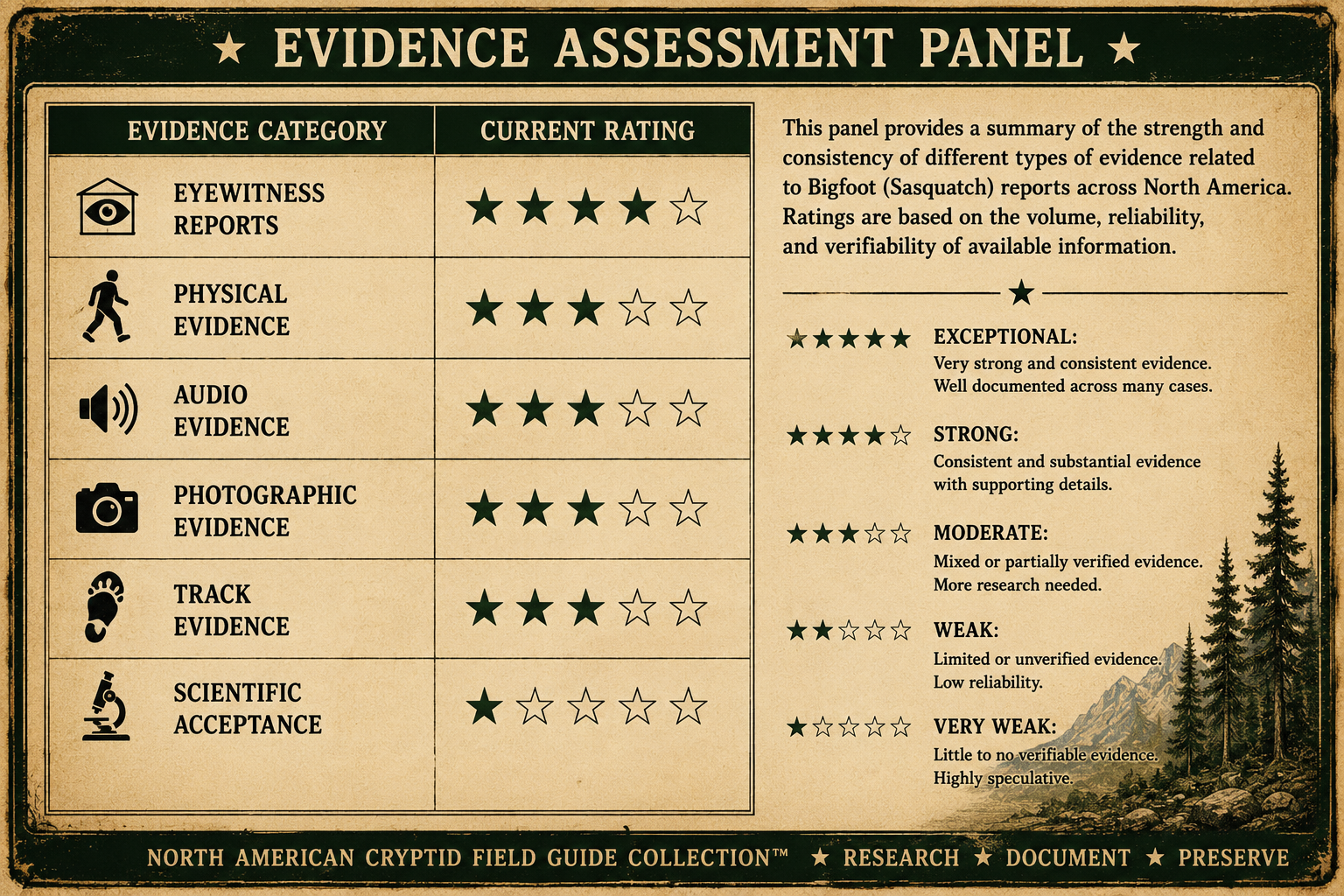
The Evidence Assessment Panel provides a visual overview of the major categories of reported Bigfoot evidence. Rather than attempting to prove or disprove the existence of Sasquatch, the panel summarizes the relative strength, consistency, and availability of information within each category. Ratings reflect commonly reported evidence found in publicly available research, historical publications, and documented field investigations.
Understanding the Ratings
Each evidence category is assigned a rating based on several factors:
- The number of documented reports
- Consistency across independent eyewitness accounts
- Availability of physical documentation
- Ability to independently examine or verify evidence
- Overall acceptance within the research community
As new discoveries are made and additional reports become available, these assessments may evolve to reflect the current state of research.
Evidence Categories
👁 Eyewitness Reports
The largest body of Bigfoot information comes from eyewitnesses, including hunters, hikers, campers, forestry workers, law enforcement officers, and rural residents. While individual accounts vary, many describe remarkably similar physical characteristics and behaviors.
👣 Physical Evidence
Researchers have documented footprints, possible hair samples, broken vegetation, tree structures, impressions, and other physical traces. Although intriguing, many findings remain open to interpretation or lack definitive laboratory confirmation.
🔊 Audio Evidence
Unexplained vocalizations, wood knocks, whistles, and howls have been recorded throughout North America. Some recordings continue to be studied because they do not clearly match known wildlife, while others remain inconclusive.
📷 Photographic Evidence
Images and video recordings occasionally emerge claiming to show Bigfoot. Advances in digital technology make careful examination essential, and most visual evidence remains debated within both the scientific and cryptid communities.
👣 Track Evidence
Footprint casts remain among the most frequently investigated forms of physical evidence. Researchers examine stride length, dermal ridge patterns, toe placement, and pressure distribution when evaluating reported tracks.
🔬 Scientific Acceptance
At present, no specimen or independently verified physical evidence has been presented that has resulted in widespread scientific recognition of Bigfoot as a confirmed biological species. Continued field investigations, open-minded research, and improved technology may help clarify future discoveries.
Ideal Bigfoot Collection Series