Physical Characteristics
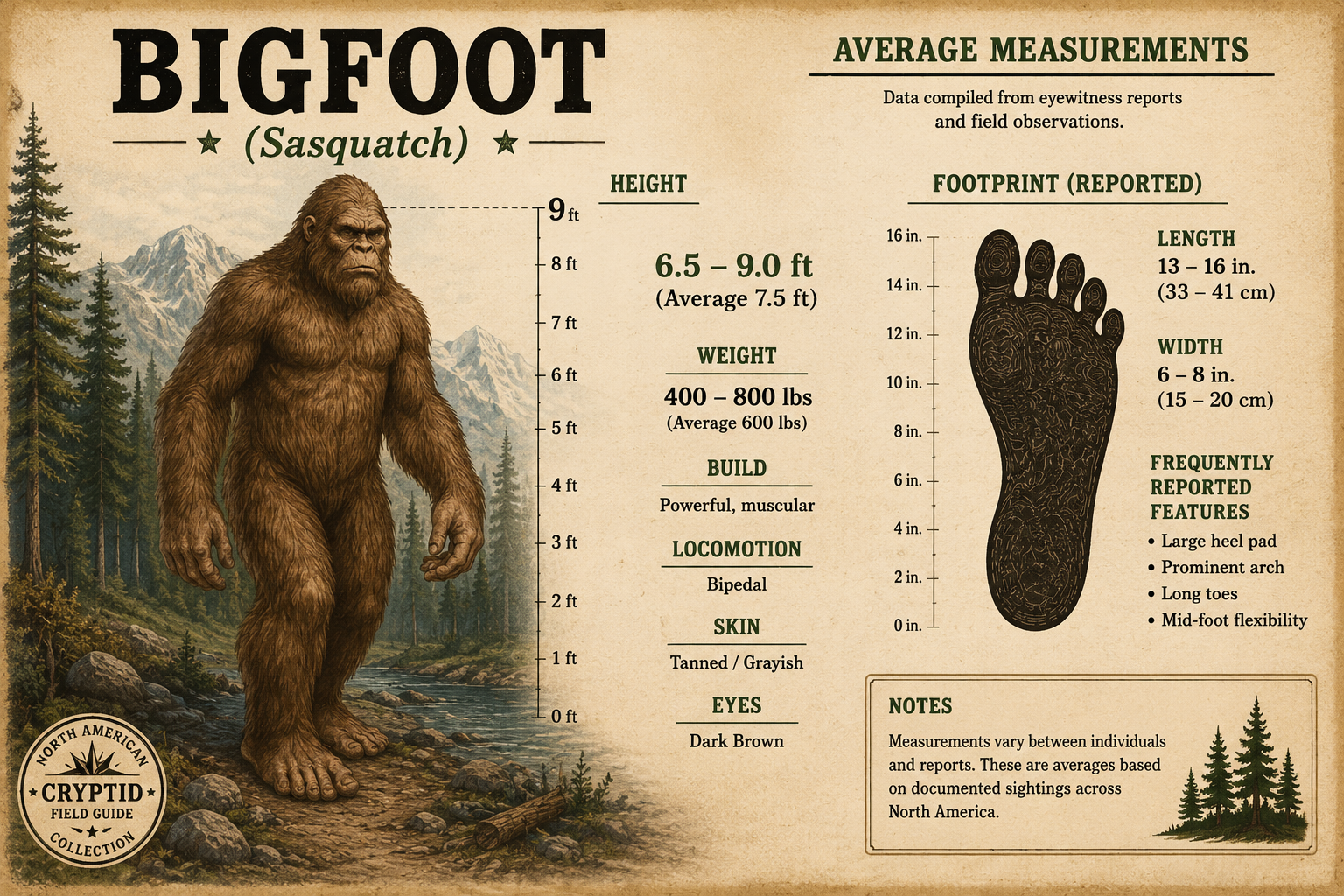
Bigfoot Average Measurements
How Big is a Sasquatch?
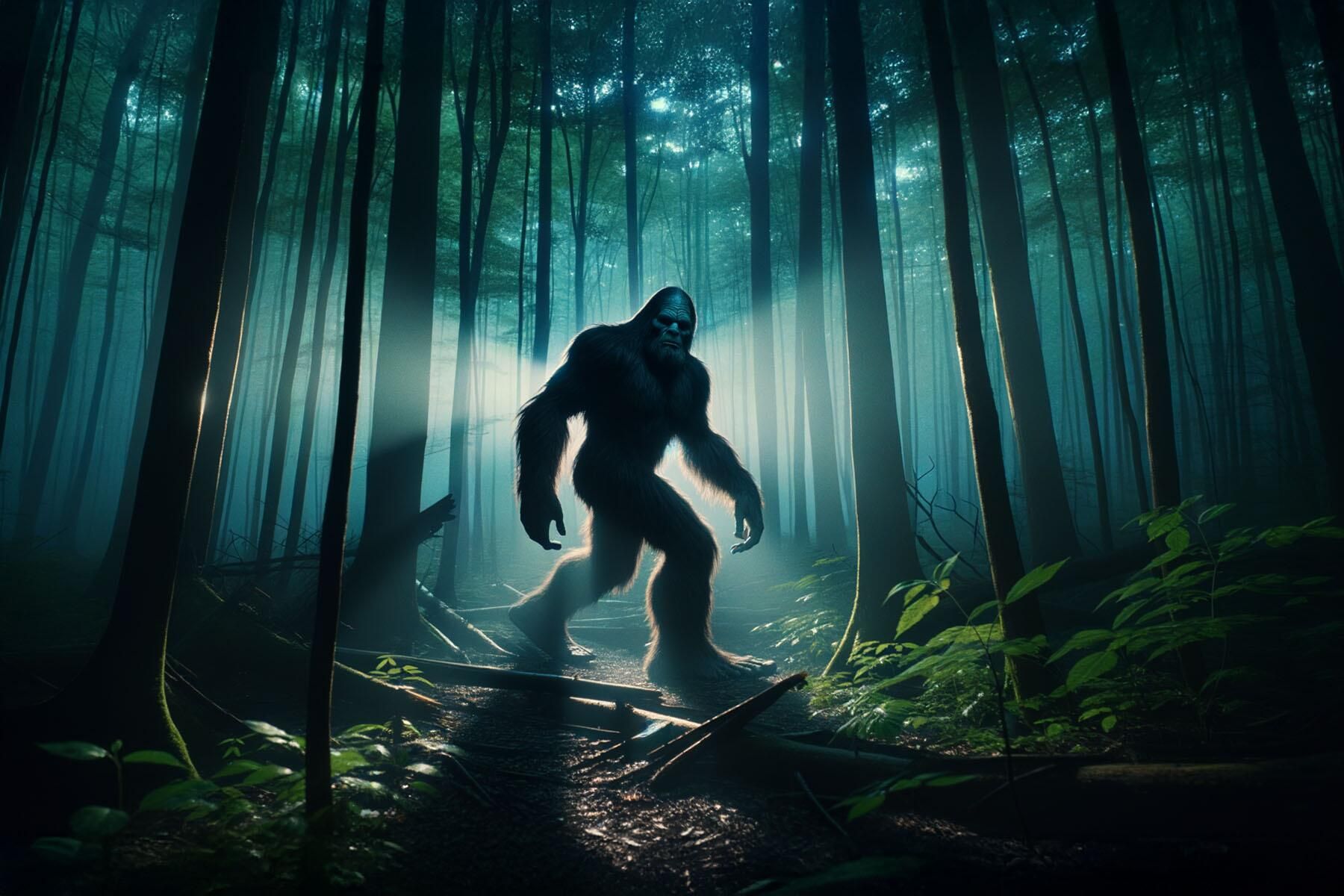
For generations, eyewitnesses across North America have described an enormous, human-like creature unlike any known animal. While no scientific consensus exists regarding Bigfoot's existence, thousands of reports collected over the past century share remarkably similar descriptions of its size, build, and physical characteristics.The measurements shown here represent the most commonly reported averages gathered from eyewitness accounts, field investigations, footprint casts, and historical reports. Individual sightings vary considerably, but many describe a creature standing between 6½ and 9 feet tall, weighing 400 to 800 pounds, with unusually broad shoulders, massive hands, and large feet measuring 13 to 16 inches long.Powerful legs, a muscular frame, and long arms are frequently cited, along with a smooth, efficient bipedal stride that allows the animal to traverse dense forests, steep mountain terrain, and remote wilderness with surprising ease. Reports consistently describe dark brown to grayish hair, deep-set eyes, and an imposing brow ridge that gives the creature its unmistakable appearance.Although these dimensions remain unverified by modern science, they provide a fascinating snapshot of the characteristics most often reported by witnesses throughout North America. Whether viewed as folklore, an undiscovered primate, or one of history's greatest mysteries, Bigfoot continues to capture the imagination of researchers, outdoor enthusiasts, and cryptid fans alike.
Quick Facts
- Reported Height: 6.5–9 feet (average approximately 7.5 feet)
- Reported Weight: 400–800 pounds
- Foot Length: 13–16 inches
- Foot Width: 6–8 inches
- Locomotion: Upright (bipedal)
- Build: Broad shoulders with exceptional muscular development
- Habitat: Dense forests, mountainous regions, and remote wilderness
- Status: Unconfirmed
Scientific Skepticism Mainstream scientists remain highly skeptical of reported Bigfoot measurements due to basic laws of biology, physics, and flawed data collection:
1.The Square-Cube Law (Biomechanical Strain)If a primate were scaled up to 9 or 15 feet tall, its weight would increase exponentially, not linearly. A 10-foot tall bipedal primate would place immense, debilitating stress on its skeletal structure, joints, and feet. Without radical, gorilla-like anatomical adaptations for distributing weight, an upright creature of that scale would struggle to walk.
2. Footprint Depth Contradictions Footprint casts often do not align with physics. For example, analyses of tracks associated with the famous Patterson-Gimlin film show that the indentations left in the mud would require a creature so heavy its body tissue would need to be as dense as titanium. When human investigators tried to duplicate the footprint depth by jumping forcefully onto the ground, they still could not press as deep, indicating the tracks may have been artificially stamped or fabricated.
3. Misidentification and Scaling Bias Human perception is notoriously poor at estimating scale in the wild. Controlled studies show that witnesses frequently overestimate the size of objects viewed through dense foliage or from a distance. Statistical models demonstrate that the vast majority of Bigfoot sightings heavily correlate with regions featuring high populations of American black bears. A black bear standing on its hind legs can easily be misidentified and visually inflated into an 8-foot "monster".
4. The Biological Baseline Every rigorous genetic analysis of physical evidence has failed to support the existence of a giant primate. In a notable study published by the Proceedings of the Royal Society B, researchers tested dozens of anomalous "Bigfoot" hair samples. The genetic results revealed the samples actually belonged to common, known wildlife, including cows, raccoons, deer, and bears.