Diet & Behavior
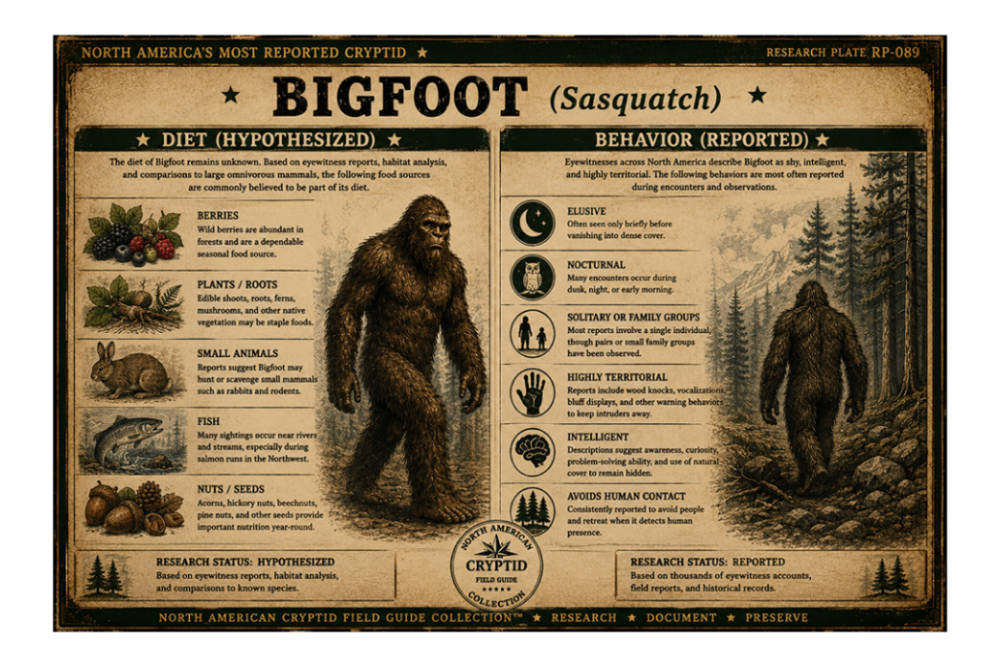
Diet (Hypothesized)
What Does Bigfoot Eat?
Because no verified biological specimen has ever been examined, the diet of Bigfoot remains one of the greatest mysteries in cryptozoology. Researchers have developed hypotheses based on eyewitness reports, track evidence, environmental observations, and comparisons with large omnivorous mammals such as bears and great apes.Many reports describe Bigfoot foraging throughout forests, mountain valleys, and river corridors where seasonal food sources are abundant. If such a creature exists, an omnivorous diet would provide the flexibility needed to survive across the diverse climates of North America.
Commonly Reported Food Sources
🍇 Berries
Wild berries provide a dependable seasonal food source and are plentiful throughout much of Bigfoot's reported range.🌿 Plants & Roots
Edible shoots, roots, ferns, mushrooms, and other native vegetation have frequently been suggested as staple foods.🦌 Small Animals
Some eyewitnesses have reported Bigfoot pursuing rabbits, rodents, or other small mammals, although no confirmed evidence exists.🐟 Fish
Reports from the Pacific Northwest often describe Bigfoot near rivers during salmon runs, suggesting fish may be an important seasonal food source.🌰 Nuts & Seeds
Acorns, hickory nuts, beechnuts, pine nuts, and other naturally occurring seeds may provide valuable nutrition throughout the year.Research Status:Hypothesized from eyewitness reports and habitat analysis.
Behavior (Reported)
Reported Behavioral Characteristics
Eyewitnesses from across North America have described remarkably similar behaviors during alleged Bigfoot encounters. Although individual accounts vary, recurring patterns have emerged throughout decades of reports, helping researchers develop a general behavioral profile.If the reports accurately describe an unknown primate, these behaviors suggest an intelligent, highly adaptable animal that avoids human contact whenever possible.
Commonly Reported Behaviors
🌙 Elusive
Often observed only briefly before disappearing into dense vegetation or rugged terrain.🌑 Nocturnal
Many reported encounters occur during dusk, nighttime, or the early morning hours.👣 Solitary or Family Groups
Most sightings involve a single individual, though occasional reports describe pairs or small family groups.🛡 Highly Territorial
Witnesses frequently report vocalizations, wood knocks, rock throwing, or bluff displays believed to discourage intruders.🧠 Intelligent
Many accounts suggest careful observation of humans, apparent problem-solving abilities, and the use of natural cover to remain concealed.🌲 Avoids Human Contact
Perhaps the most consistent feature across thousands of reports is the creature's apparent preference for avoiding direct interaction with people.Research Status:Behavioral profile compiled from publicly documented eyewitness reports and historical field investigations.